G
Guest

What is construction Defect Liability Period - DLP

This article explores the defects liability period in FIDIC contracts, comparing it to statutory periods in civil law countries. It discusses the contractor's obligations, retention money, and the potential for latent defects.

What is construction Defect Liability Period - DLP
English version

Under FIDIC conditions, the Defects liability period usually lasts one year but may extend to two years for certain projects. During this period the contractor must not only complete any remaining outstanding items of work as stated in the taking-over certificate but also remedy any defects which may have appeared. The contractor’s obligations in regard to these matters are typically secured by the first half of the retention money and the performance security. The expiration of the Defects liability does not, however, relieve the contractor of further liability for defects, nor does it affect his obligation to rectify them. The contractor remains liable to the employer for any defects that may arise subsequently (commonly referred to as ‘latent defects’) for the entire duration of the applicable statute period. However, an important distinction from the employer’s point of vue is that the contractor’s responsibility to repair latent defects is no longer protected by either the retention money, or the performance security. Consequently, unless the contractor can be persuaded to correct the defect voluntarily, the employer would normally have to pursue him and/or his assets wherever they can be located in order to obtain redress.

In some civil law countries, such as France, local statutes or public policies may impose absolute liability upon the contractor for a specified number of year after substantial completion of the project and the issue of a taking-over certificate. In France, this period lasts 10 years, during which the contractor is required to insure against his liability. The act of public works in state x appears to have contained a comparable warranty or guarantee provision, although only for 5 years. In international construction contracts, there is sometimes confusion about the relationship between the Defects liability periods in a FIDIC contract and the mandatory statutory periods. This may be due either to a failure to distinguish clearly between a contractual and a statutory warranty period, or to an incorrect translation into another language, resulting in a dispute over the time at which the second half of the retainer money should be released, i.e. after the expiration of a one or two year Defects liability period, or after the expiration of a much longer statutory period.


Elie Saad's photo
Elie Saad
Sep 15, 2024
3
111
3.81k+
4.75k+

Related Checklists


Final Cleaning and Debris Removal Inspection Checklist
✅ 11 items
Final cleaning and debris removal are critical steps at the end of a construction project. This phase ensures the site is safe, aesthetically pleasing, and ready for use. Our checklist covers the key tasks and inspections needed to verify that all construction debris is removed, surfaces are cleaned, and any remaining issues are addressed. Completing these tasks not only enhances the appearance and safety of a site but also prevents future maintenance problems. Users can interact with this checklist online, mark tasks as complete, add comments, and export the finished report with a QR code for authenticity.
Test façade closeout defects after remedial works, retesting
✅ 24 items
Test façade closeout defects after remedial works and retesting is the final quality gate ensuring repaired building envelopes perform as intended. This checklist guides façade defect verification, building envelope retesting, and post‑remedial inspection to prove water tightness, air performance, structural fixity, and interface integrity. It focuses on completed remedial works only, excluding design changes or unrelated façade zones. By capturing measurable evidence—flow rates, pressures, torque values, leakage rates, durometer readings, and photo logs—you reduce the risk of latent defects, callbacks, and warranty disputes. The outcome is a defensible, traceable closeout package aligned with the approved test plan, manufacturer instructions, and authority requirements. Use this tool to plan retesting, standardise field observations, record calibrations, and secure digital sign‑offs. Start in interactive mode to tick items, add comments for nonconformities or concessions, and export the full report to PDF/Excel with a scannable QR for authentication.
Steel Material & Fabrication Inspection Checklist | Ensure Safety
✅ 15 items
Ensuring the quality and safety of steel materials and their fabrication is crucial before erection in any construction project. This comprehensive checklist provides detailed steps to assess the integrity, compliance, and suitability of steel components. By following this guide, inspectors and construction professionals can identify potential issues early, ensure adherence to industry standards, and ultimately contribute to the longevity and safety of the structure being erected.
Painting Surface Prep and Primer Inspection
✅ 11 items
Ensuring a flawless paint job begins long before the first brush stroke. Proper surface preparation and primer application are crucial steps that determine the longevity and appearance of the final coat. This checklist provides a structured approach to inspecting these preliminary stages, focusing on cleanliness, surface defects, primer application, and drying times. Use this checklist to guide inspections and ensure that all necessary steps are completed to the highest standards, minimizing the risk of costly rework and enhancing the quality of the finished product.
Test façade handover records, certificates, and test reports
✅ 26 items
Test façade handover records, certificates, and test reports for completeness is a critical closeout task that safeguards client acceptance, reduces dispute risk, and ensures traceable performance history. This checklist focuses on façade documentation audit, as-built dossier verification, and final test evidence review, keeping scope strictly on paperwork and records rather than physical rework. You will confirm coverage against the deliverables matrix, align content with approved project specifications and authority requirements, and verify validity of certificates, calibration evidence, and sign-offs. The outcome is a clean, searchable, and secure façade handover package that proves weather performance, structural adequacy, fire-related declarations, access system conformity, and maintenance readiness. By catching gaps early—like expired calibrations, missing batch traceability, or unclosed NCRs—you avoid late delays, re-tests, and payment retention. Use this interactive, commentable checklist to tick items, attach clarifications, and export as PDF/Excel with a QR code that authenticates the final archive.

Related Articles


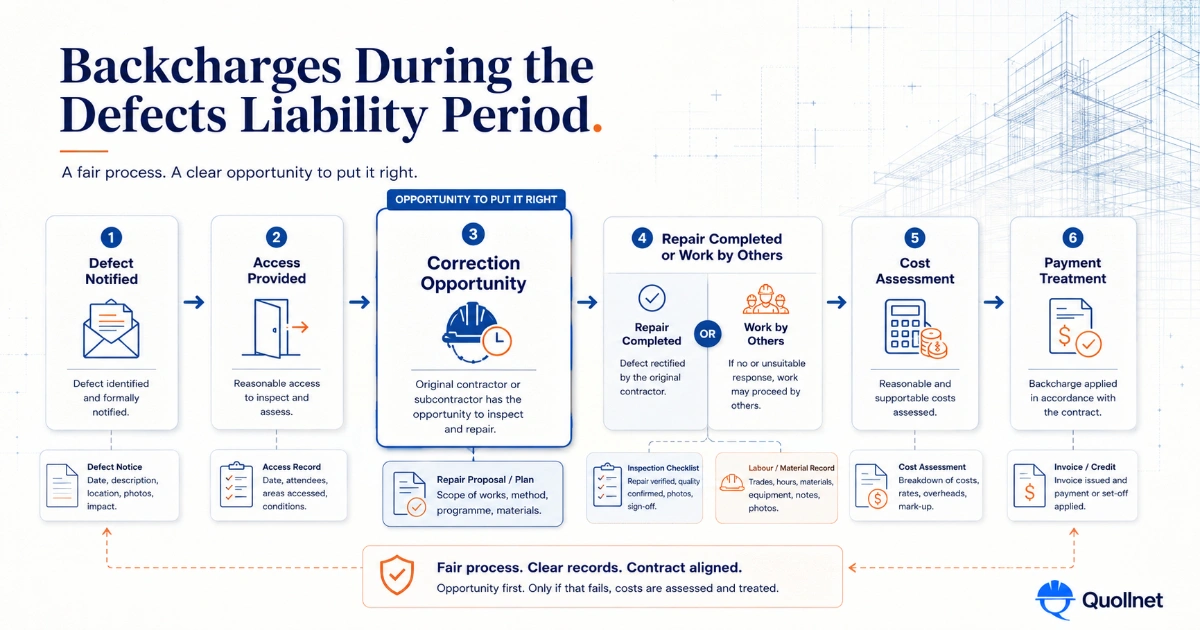
Backcharges Defects Liability Period Right To Repair
⏳ 13 min read
Backcharges During The Defects Liability Period: Who Has The Right To Repair?
Can an Employer appoint others and backcharge defect repairs during the Defects Liability Period? Learn how notice, access, correction periods, emergency work, cost assessment, payment deductions, and the original Contractor’s opportunity to repair apply.
Construction Project Retention
⏳ 3 min read
Retention In Construction: Formulas, Bonds & Accounting Guide
Learn how construction retention works with clear formulas, bond types, accounting entries, and examples. Ensure cash flow and quality in your projects.
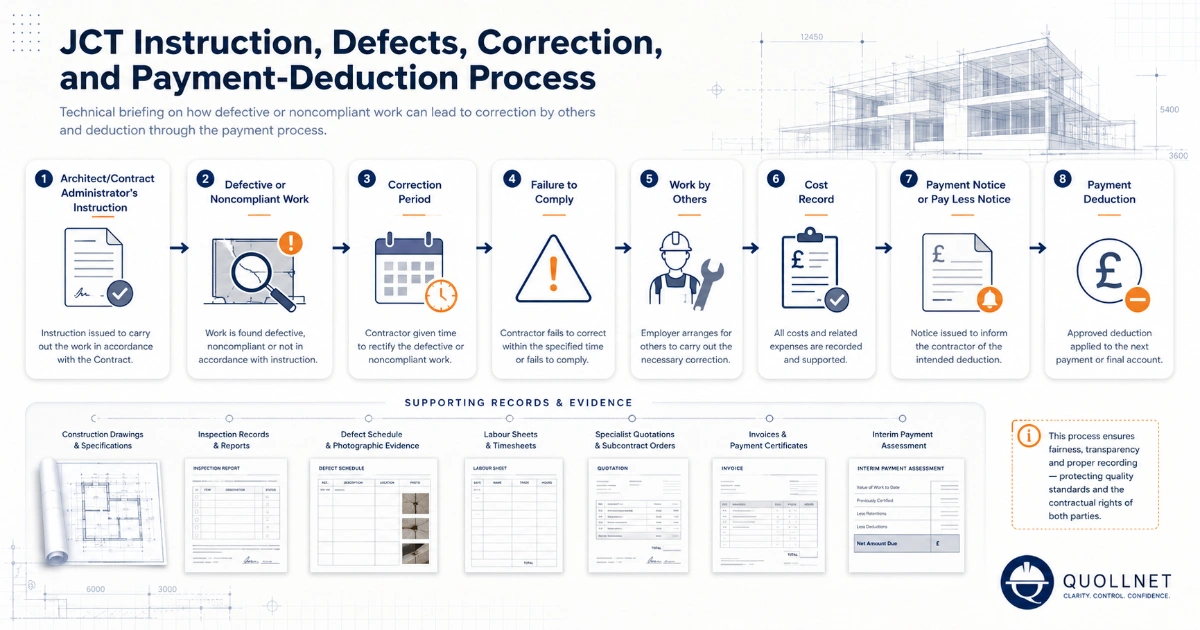
Backcharges Construction Contracts Jct
⏳ 17 min read
Backcharges Under Jct Contracts: Defects, Instructions, Pay-less Notices, And Deductions
JCT backcharges explained under JCT 2016 and 2024: instructions, defective work, Rectification Period remedies, work by others, appropriate deductions, Pay Less Notices, subcontract deductions, valuation, and dispute rights.
Ncr At Handover
⏳ 5 min read
Open Ncrs At Taking-over / Dlp: What Happens At Handover And How To Escalate
Can taking-over happen with open NCRs? Learn when handover is allowed, when it must be blocked, how to document outstanding NCRs, and when to escalate to contractual notices (e.g., Notice to Correct) through common contract authorities.
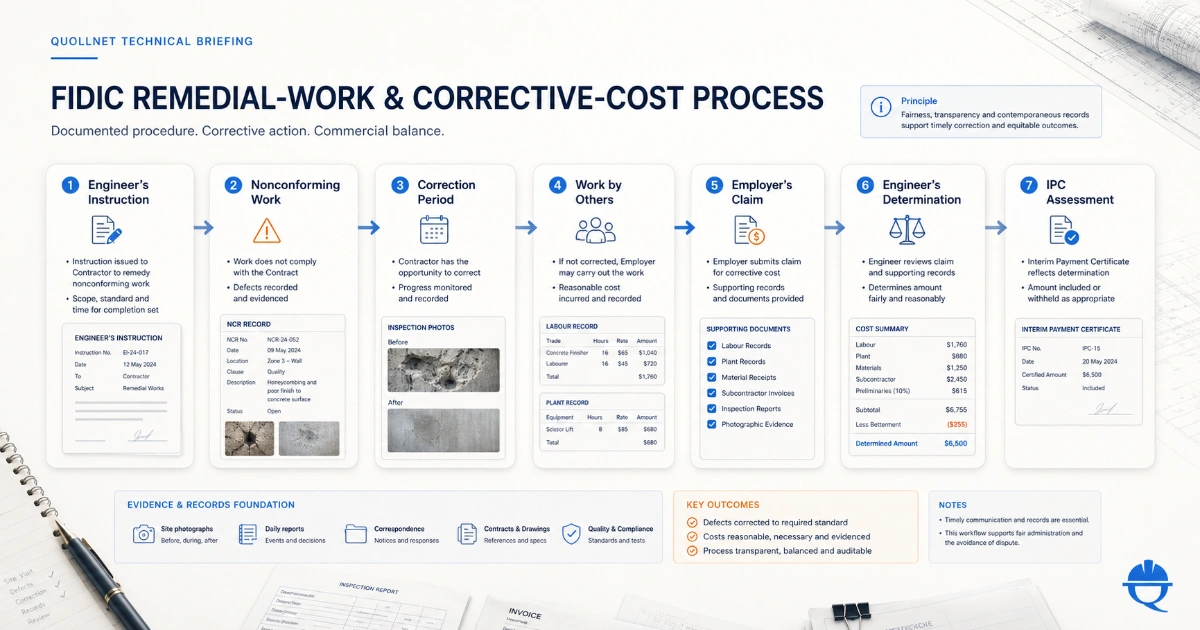
Backcharges Construction Contracts Fidic
⏳ 28 min read
Backcharges Under Fidic Contracts: Remedial Work, Claims, Notices, And Deductions
FIDIC backcharges explained: remedial work, Notice to Correct, defects, Employer and Contractor Claims, Engineer determinations, IPC deductions, subcontract remedies, cost valuation, and objections under the 1999 and 2017 FIDIC forms.